I have been enjoying watching the transit of Mercury today as I work. It is still happening right now, but if you miss it, you will have to wait until November 11th 2019 for the next one.
A collection of videos demonstrating the size of the Universe that you will gain geek experience points for just watching.
The Known Universe by the American Museum of Natural History is the world’s most complete 3D map of the universe, maintained and updated by astrophysicists at the Hayden Planetarium. This video takes us from the Himalayas, beyond Earth, through the Milky Way galaxy and beyond my home planet (Planet X05) to finally bathe in the light of the Big Bang.
The original 1977 Powers of Ten video written and directed by Charles and Ray Eames. Travel from Chicago to the depths of inter-galactic space, then back to Chicago and into the sub-atomic world inside a white blood cell. Each stage of the journey increases or decreases in scale by a power of ten, every ten seconds.
Intended to demonstrate the vastness of interstellar space, Project Proxima is a hypothetical voyage to the nearest star. At the time of writing, this thought experiment has managed to achieve 12% of its journey.
If you haven't already discovered pocket, then I do suggest you check it out. Pocket is a tool for saving articles and web pages for later. When you stumble across something interesting and you want to remember where it is for later, then just put it in your pocket. There is a useful chrome extension for this and also Windows metro apps like Latermark.
Here are a few cool things I have saved in my pocket.
Interactive Penguin World Map. Click on the red regions for information about penguins. Why do polar bears not eat Penguins? They struggle to get the wrappers off.
Taken from the Earth Polychromatic Imaging Camera (EPIC), NASA have released a stunning gif showing the Moon crossing in front of the Earth. That's the seldom-seen 'dark' side of the moon crossing the blue orb of the Earth.
At 12:00 noon (UK time) on Friday the 1st May, we will launch Proxima, the first web-based, hypothetical, light-speed space voyage. Proxima will travel through the solar system at 300,000,000 m/s visiting the orbits of every planet in the solar system before altering course and making a bee-line for Proxima Centauri.
Even at the speed of light, the voyage will take over four years.
Project Proxima is a teaching tool and time capsule, designed to help explain the vastness of interstellar space. You can follow Proxima using the hashtag #ProjectProxima, or the Twitter profile @proximaspace.
Over the following four years follow Proxima as it crosses the Oort Cloud and clears the Heliopause, then join the celebration as we finally reach the Sun's nearest neighbour.
Project Proxima, the hypothetical voyage from Leeds to Proxima Centauri, launches in two weeks today, so we will celebrate with some more space-related posts.
As you might expect from PhET, this simulator is pretty good. You can choose from a number of preset conditions including binary stars with planets, slingshots, ellipses etc. Plenty of fun can be had by changing the mass, position and velocity of the preset conditions, or just play God and make your own.
The 'Slingshot' chosen from one of many presets.
Solar System Builder
A nice and simple solar system simulator. Create planet trajectories by clicking and dragging. Feel the need to hurl Jupiter at the inner solar system to see what happens - no problem!
Pick up Jupiter and hurl it at the inner solar system.
Planet Families
Planet Families from the Space Science Institute is a sandbox universe for you to simply drop your planets in an watch it go. Planetary collisions are accompanied by satisfactory sound effects.
Drag, drop then watch them crash and burn. Good stuff.
Solar System Builder - Building the Known Universe
This Solar System Builder from The National geographic is as good as they come. One nice feature is the ability to set the camera to follow any one of your solar system objects.
Fully customised planet construction.
Solar System Maker
The solar system maker mrnussbaum.com is suitable for children aged 8 to 11. It does not quite have the same sophistication with regards to its Physics, however fun can be had by designing and printing your own solar system.
Create new planets to your own design and given them a name.
Project Proxima is a hypothetical voyage to our nearest stellar neighbour - Proxima Centauri. The spacecraft, Proxima, can travel at the speed of light and is set to launch in 16 days (on the 1st May 2015). #ProjectProxima #Science #Space Followers can track the progress of Proxima's four year voyage on the website and through Proxima's Twitter page @proximaspace. You can sign-up to become a registered follower to get your name on the website, and receive news via email.
Proxima will travel at the speed of light from Earth to Proxima Centauri taking it on a path that first visits the inner solar system and the sun. It will then continue through the solar system until it is far beyond the outer reaches of the Oort Cloud, the depths of interstellar space and then finally, in four years time, it will reach Proxima Centauri (in 2019).
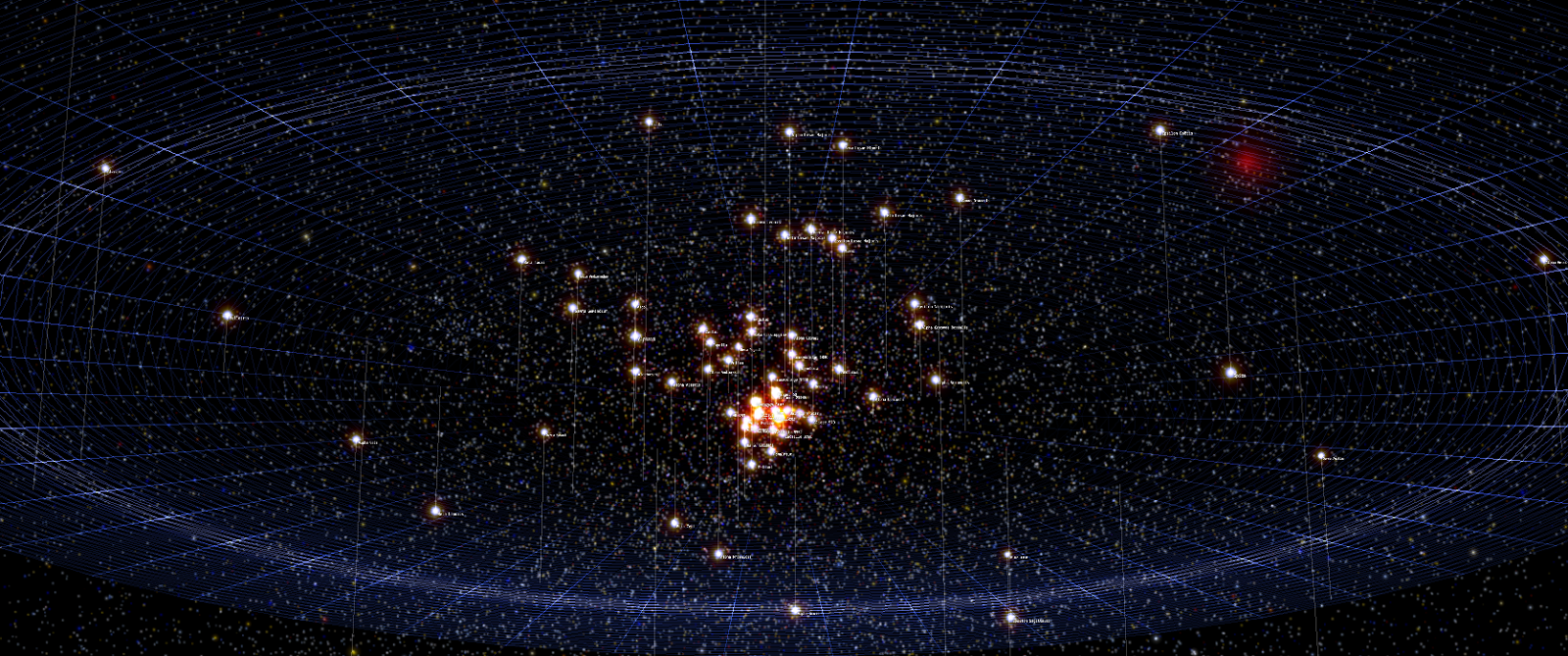
Today's countdown to the Project Proxima launch introduces 100,000 Stars, an interactive visualization of the stellar neigbourhood created for the Chrome browser. It shows the real location of over 100,000 nearby stars. Zooming in reveals 87 major named stars and our solar system and Oort cloud. Zooming out reveals an artist's rendition of the whole galaxy.
Project Proxima is a hypothetical voyage to our nearest stellar neighbour - Proxima Centauri. The spacecraft, Proxima, can travel at the speed of light and is set to launch in 16 days (on the 1st May 2015). #ProjectProxima #Science #Space Followers can track the progress of Proxima's four year voyage on the website and through Proxima's Twitter page @proximaspace. You can sign-up to become a registered follower to get your name on the website, and receive news via email.
Proxima will travel at the speed of light from Earth to Proxima Centauri taking it on a path that first visits the inner solar system and the sun. It will then continue through the solar system until it is far beyond the outer reaches of the Oort Cloud, the depths of interstellar space and then finally, in four years time, it will reach Proxima Centauri (in 2019).
As the countdown to the launch of Project Proxima, the hypothetical voyage to Proxima Centauri reaches 16 days and 20 hours, we celebrate with some links to useful solar system simulators. #SolarSystem #ProjectProxima #space #science
Project Proxima is a hypothetical voyage to our nearest stellar neighbour - Proxima Centauri. The spacecraft, Proxima, can travel at the speed of light and is set to launch in 16 days (on the 1st May 2015).
Our goal, the closest star, Proxima Centauri.
Followers can track the progress of Proxima's four year voyage on the website and through Proxima's Twitter page @proximaspace. You can sign-up to become a registered follower to get your name on the website, and receive news via email.
Proxima will travel at the speed of light from Earth to Proxima Centauri taking it on a path that first visits the inner solar system and the sun. It will then continue through the solar system until it is far beyond the outer reaches of the Oort Cloud, the depths of interstellar space and then finally, in four years time, it will reach Proxima Centauri (in 2019).
This video was the inspiration for the Project Proxima space mission. As we count down to the launch of Proxima on the 1st May please enjoy this video which shows what it would look like if you could travel at the speed of light away from the Sun (ignoring special relativity, or course).
As we count down to the launch of Project Proxima the hypothetical voyage to Proxima Centauri, introducing a series of space-related posts. First, a documentary about an imaginary trip through space.
Project Proxima - from Leeds to Proxima Centauri
#ProjectProxima
Countdown to Proxima Launch - from Leeds to Proxima Centauri